


You may also like
-

Childhood Group IV Poster
Hilma af Klint · 1907 · Radiant abstract art print with spiraling forms and pastel colors evoking childhood energy
Poster from €9 · Framed from €16
-

The Ten Largest No. 8 Poster
Hilma af Klint · 1907 · Ethereal abstract art print of spirals and symbolic forms in pink, yellow, and blue
Poster from €9 · Framed from €16
-

The Ten Largest, No. 6 Poster
Hilma af Klint · 1907 · Radiant abstract poster of swirling forms and symbols in soft pinks and purples
Poster from €9 · Framed from €16
-

The Ten Largest No 7 Poster
Hilma af Klint · 1907 · Radiant abstract art print with swirling biomorphic forms on a sunlit yellow field
Poster from €9 · Framed from €16


-

"Very nice Posters. The quality is amazing and we received it very quickly !"
-

"A shop to visit absolutely. Huge selection of posters. We spent more than an hour there !"
-

"Perfect to find gift. Price are very good. An they can frame and pack it on site"


About the Artist
Hilma af Klint was a Swedish painter whose groundbreaking experiments placed her among the earliest pioneers of abstract art. Trained at the Royal Academy of Fine Arts in Stockholm, she balanced conventional commissions with a private, visionary practice deeply influenced by spiritualism and theosophy.
Her most innovative works remained largely unseen during her lifetime, leading to a delayed recognition of her influence on modern art. Today, af Klint is celebrated in curated famous artists wall art collections that highlight her unique blend of mysticism and abstraction.
The Artwork
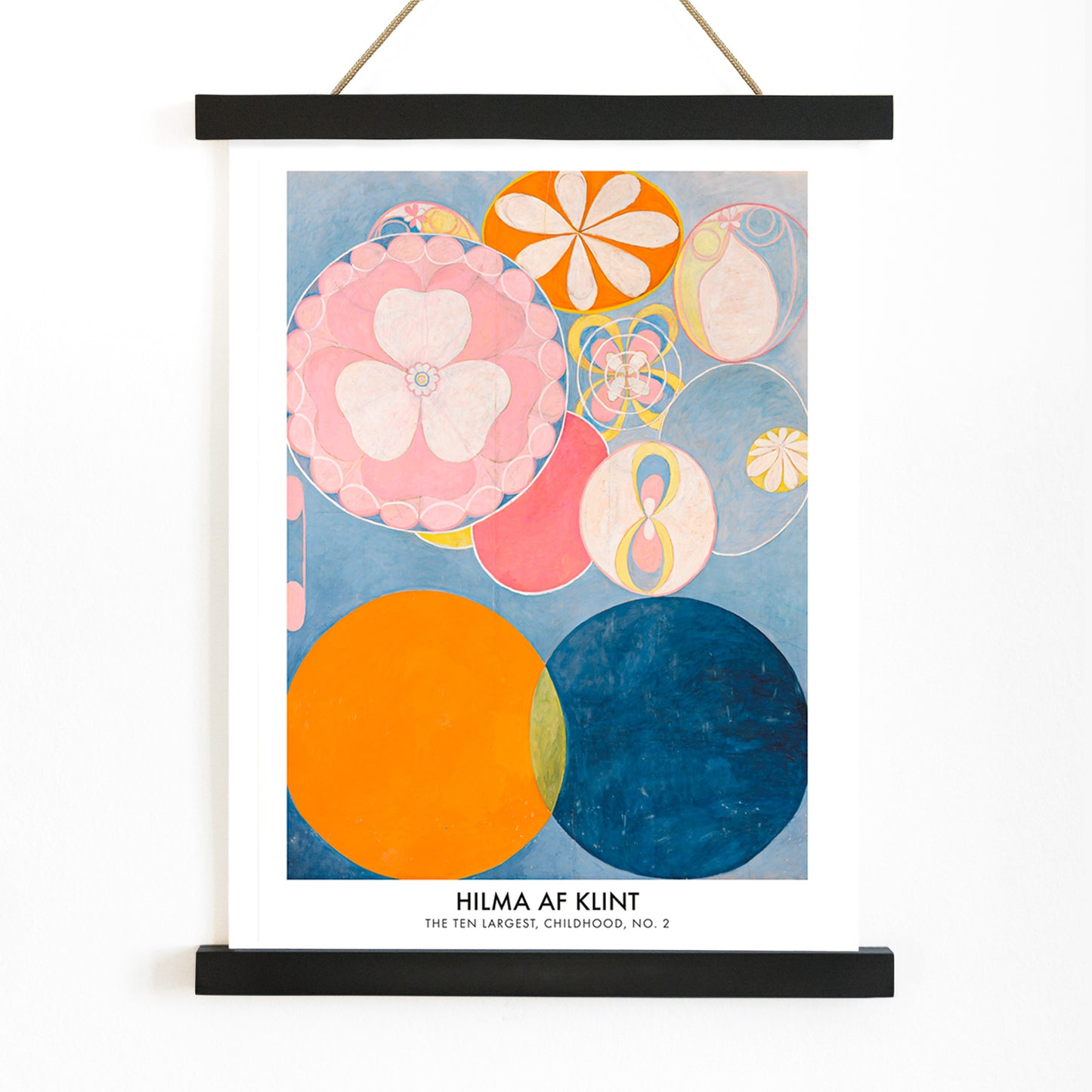
Created in 1907, The Ten Largest, Childhood, No 2 is part of a monumental series exploring the stages of human life. Rather than depicting childhood as a literal scene, af Klint approached it as a phase of transformation and spiritual growth, reflecting her belief in art as a guide through existence.
This cycle was conceived for a spiritual context, often imagined as adorning a temple-like space, and was intended to inspire contemplation of life's progression. The work stands as a key example of early twentieth-century esoteric art, merging abstract language with symbolic meaning.
Style & Characteristics
The composition is expansive and dynamic, featuring large, rounded organic shapes that float and interlock across the surface. Spiraling lines, gentle curves, and small glyph-like marks create a sense of movement and coded communication.
A harmonious palette of blue, pink, orange, yellow, and white lends the piece a luminous, uplifting quality. Soft transitions between colors and confident contours evoke both playfulness and introspection, making this abstract art print a striking choice for lovers of abstract posters.
In Interior Design
This fine art print introduces a vibrant yet serene energy to living rooms, bedrooms, or creative spaces, especially where subtle color is desired. It complements Scandinavian, mid-century, and minimalist interiors that emphasize openness and light.
Pair it with neutral walls, pale woods, or soft textiles to highlight its gentle hues, or echo its colors through accessories for a cohesive look. Its theme of growth and transformation makes it especially fitting for family areas or spaces dedicated to creativity and reflection.