


You may also like
-
Color Patchwork Poster
Otto Freundlich · 1936 · Vibrant abstract poster of interlocking color tiles unified by bold black outlines
Poster from €9 · Framed from €16
Regular price From €6,00Regular price -
Composition Abstraite Poster
Otto Freundlich · 1937 · Vibrant geometric art print of interlocking color blocks outlined in black
Poster from €9 · Framed from €16
Regular price From €6,00Regular price -
Komposition (1939) Poster
Otto Freundlich · 1939 · Geometric abstract poster featuring earthy browns with blue and yellow accents
Poster from €9 · Framed from €16
Regular price From €6,00Regular price -
Fragments de figure Poster
Otto Freundlich · 1928 · Vibrant geometric poster of a fragmented figure with bold black outlines
Poster from €9 · Framed from €16
Regular price From €6,00Regular price


-

"Very nice Posters. The quality is amazing and we received it very quickly !"
-

"A shop to visit absolutely. Huge selection of posters. We spent more than an hour there !"
-

"Perfect to find gift. Price are very good. An they can frame and pack it on site"


About the Artist
Otto Freundlich 1878 to 1943 was a German avant garde painter and sculptor whose work helped shape early European abstraction. Active in both Paris and Germany, Freundlich sought to create a universal visual language rooted in pure form and color, aligning with the ideals of Cubism and the broader modernist movement.
As a Jewish artist, Freundlich was persecuted by the Nazi regime and his works were labeled as degenerate art. Today, his contributions are recognized among key modern masters, appreciated for their humanist vision and innovative simplicity.
The Artwork
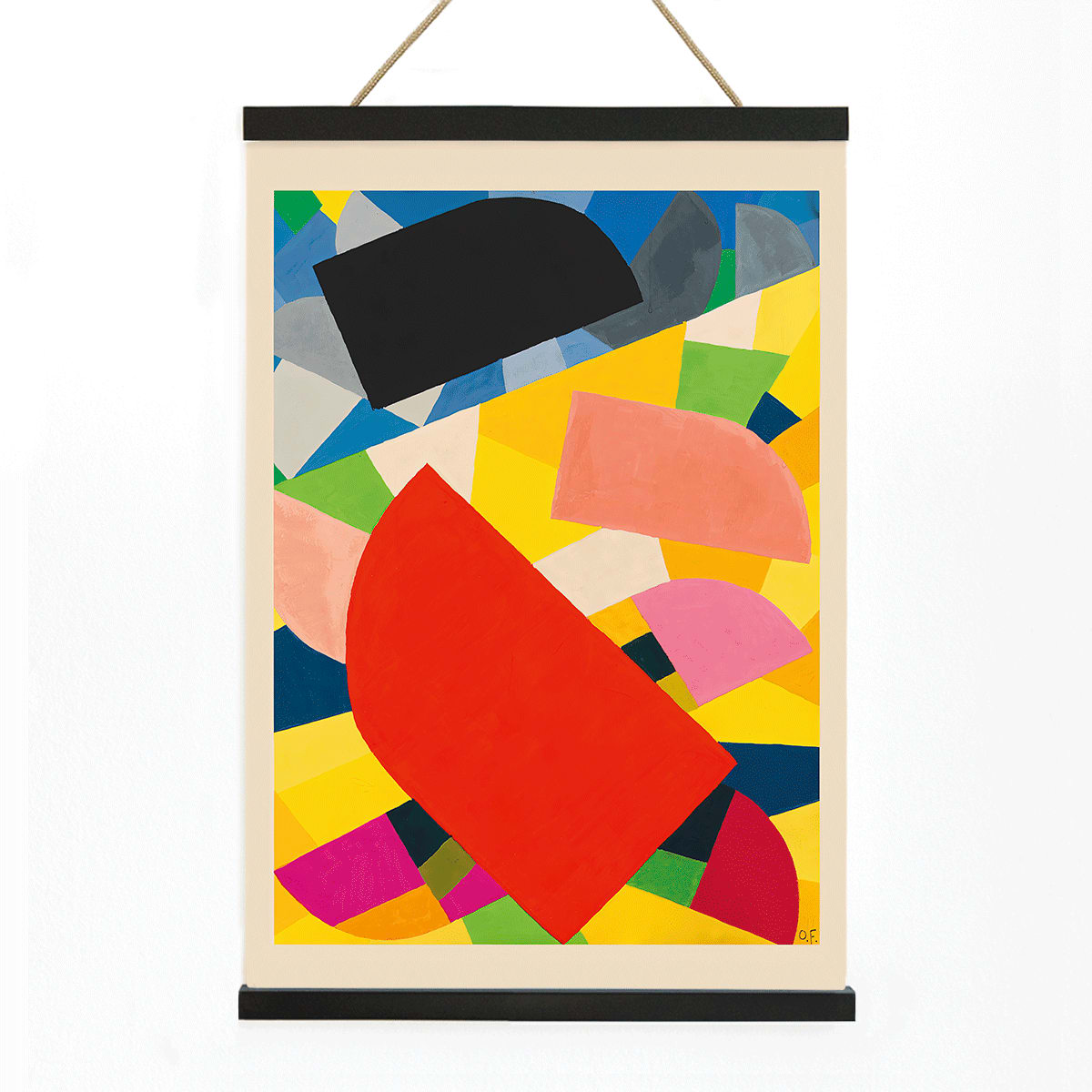
Komposition from 1936 emerged during a period of social and political upheaval, when abstraction offered artists a way to envision harmony beyond national boundaries. Freundlich’s approach was to build a sense of unity and order through carefully arranged geometric forms, reflecting a belief in art’s power to inspire hope and resilience.
This work was part of a broader movement that saw abstract art as a progressive force in culture. As a fine art print, it continues to embody optimism and the search for balance in turbulent times.
Style & Characteristics
The composition features interlocking geometric shapes outlined by bold dark lines, creating a mosaic-like effect. Flat areas of color—warm reds, yellows, and oranges—are juxtaposed with cooler greens and pinks, while black accents provide structure and definition.
The overall effect is dynamic yet harmonious, guiding the viewer’s gaze across angled planes. The abstract style, reminiscent of Bauhaus principles, makes this piece especially appealing to those interested in abstract posters and modern graphic design.
In Interior Design
Komposition serves as a striking art print for living rooms, hallways, or creative workspaces, offering vibrant color without overwhelming the space. Its geometric clarity pairs well with mid-century or Scandinavian interiors, and it can anchor a gallery wall alongside other modernist works.
To integrate this piece, echo one or two of its colors in your textiles or ceramics, while keeping the rest of the palette neutral. It also complements curated Bauhaus style wall art and minimalist frames for a refined, gallery-like atmosphere.