


You may also like
-
Das kleine Witzblatt Poster
Julius Klinger · 1901 · Advertising poster as a bold vintage print in black and orange
Poster from €9 · Framed from €16
Regular price From €6,00Regular price -
Hollerbaum und Schmidt Poster
Julius Klinger · 1910 · Spiraling advertising poster with a small suited figure and bold red-blue bands
Poster from €9 · Framed from €16
Regular price From €6,00Regular price -
Falbalas et fanfreluches: La paresse Poster
George Barbier · 1925 · Art Deco fashion print featuring a reclining woman in bold pochoir colors
Poster from €9 · Framed from €16
Regular price From €6,00Regular price -
Woman with poppies by Alphonse Mucha Poster
Alphonse Mucha · 1899 · Elegant Art Nouveau poster featuring a tranquil woman encircled by vivid red poppies
Poster from €9 · Framed from €16
Regular price From €6,00Regular price


-

"Very nice Posters. The quality is amazing and we received it very quickly !"
-

"A shop to visit absolutely. Huge selection of posters. We spent more than an hour there !"
-

"Perfect to find gift. Price are very good. An they can frame and pack it on site"


About the Artist
Moriz Jung was an Austrian illustrator and graphic designer closely associated with the Wiener Werkstätte, a pioneering collective that transformed Viennese visual culture in the early 20th century. Working in the years leading up to the First World War, Jung contributed to a new language of poster art that combined wit, clarity, and a modern sense of style. His work remains highly regarded among collectors of early European vintage advertising posters and admirers of Secession-era design.
Jung's posters often captured the spirit of urban life, observing the habits and rituals of Vienna with a keen, humorous eye. His ability to distill character and atmosphere into graphic form set him apart within the vibrant creative scene of his time.
The Artwork
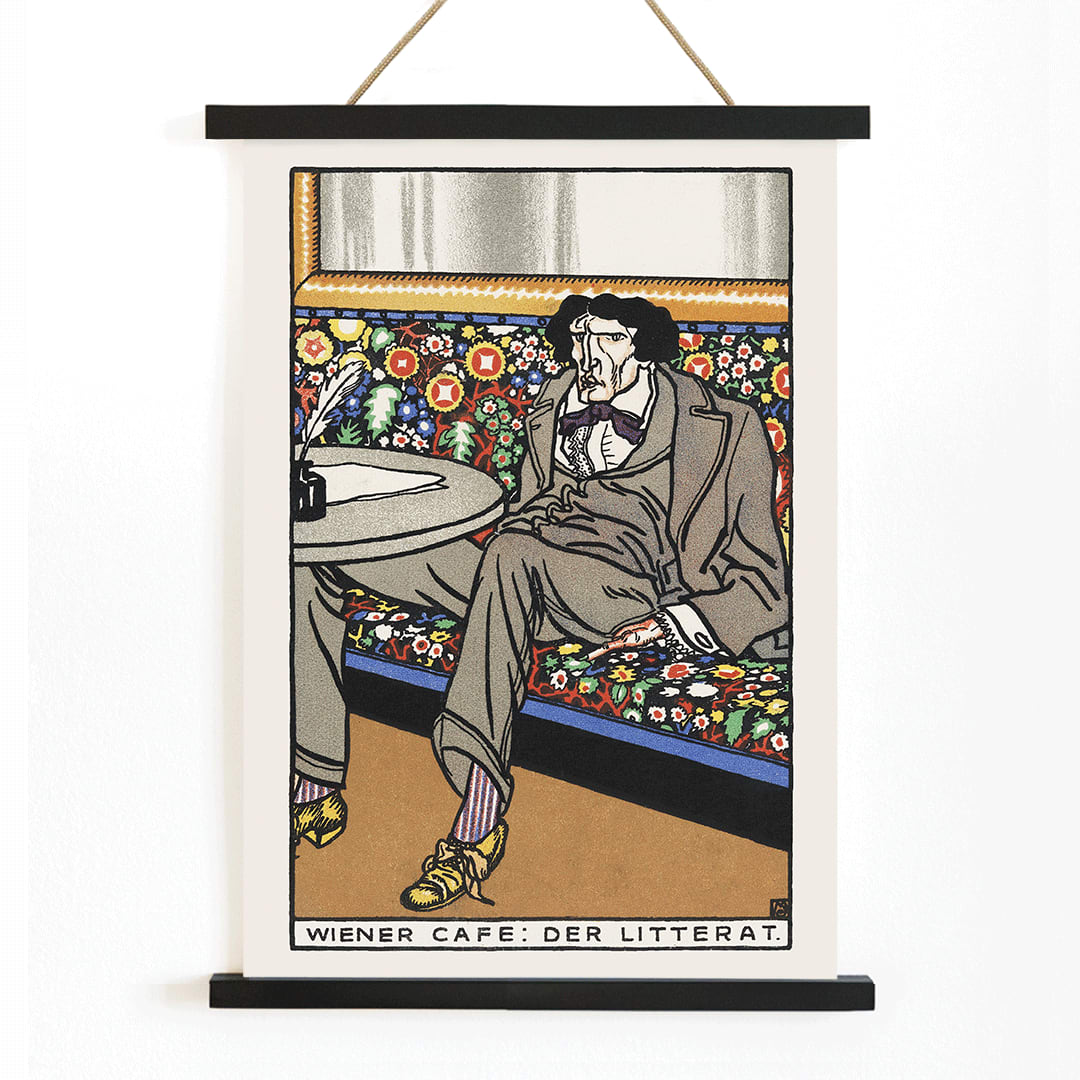
Created in 1911, The Man of Letters reflects the intellectual life of Vienna, where cafés served as gathering places for writers, thinkers, and artists. The artwork evokes a world in which reading and correspondence were central to daily existence, and where public spaces became stages for the performance of intellect and identity. This poster is both a tribute to the role of the written word in shaping modern life and a document of a city that valued design as an everyday experience.
As a product of its era, the piece also illustrates how print media and graphic design influenced the way people engaged with culture, news, and ideas in early 20th-century Vienna.
Style & Characteristics
The composition features a solitary figure seated at a café table, drawn with bold, confident lines and simplified shapes characteristic of the Wiener Werkstätte style. Large areas of grey and black define the space, while touches of yellow, red, and blue provide visual interest and a playful accent. The use of negative space enhances the clarity and immediacy of the image, making it striking from a distance.
The overall mood is sophisticated and subtly humorous, capturing the urbane atmosphere of Viennese café society. This aesthetic makes the poster an appealing choice for those interested in classic art and early modernist graphic design.
In Interior Design
This vintage café poster brings an air of cultured conversation to studies, libraries, dining rooms, or offices. It complements both modernist interiors and more eclectic spaces, pairing well with mid-century furniture or classic wood accents.
To echo the artwork's palette, consider incorporating soft greys and neutrals with small pops of primary color in your decor. Displayed as a vertical piece, it also fits seamlessly among vertical posters in a hallway or reading nook.