


You may also like
-

La Decoration Arabe 3 Poster
Emile Prisse dAvennes · 1885 · Intricate geometric poster balancing red, black, and white Islamic pattern symmetry
Poster from €9 · Framed from €16
-

Les éléments de l’art arabe 1 Poster
Jules Bourgoin · 1879 · Precise geometric poster of interlaced star patterns in crisp black ink
Poster from €9 · Framed from €16
-

Les éléments de l’art arabe 3 Poster
Jules Bourgoin · 1879 · Intricate Islamic geometry poster with interlaced lines forming a balanced black and white lattice
Poster from €9 · Framed from €16
-

Moresque 5 Poster
Owen Jones · 1899 · Vivid Moorish-inspired geometric poster with interlaced stars and bold color contrasts
Poster from €9 · Framed from €16


-

"Very nice Posters. The quality is amazing and we received it very quickly !"
-

"A shop to visit absolutely. Huge selection of posters. We spent more than an hour there !"
-

"Perfect to find gift. Price are very good. An they can frame and pack it on site"


About the Artist
Emile Prisse dAvennes was a French archaeologist, draftsman, and historian whose meticulous surveys of Egypt in the nineteenth century played a pivotal role in shaping European appreciation of Islamic art and architecture. His dedication to documenting architectural ornament helped preserve intricate patterns that might otherwise have been lost to time.
Through his influential publications, Prisse dAvennes introduced Islamic geometric design to a wider audience of artists, architects, and scholars. His work continues to serve as a foundational reference for those interested in the history of ornamentation and cross-cultural artistic exchange.
The Artwork
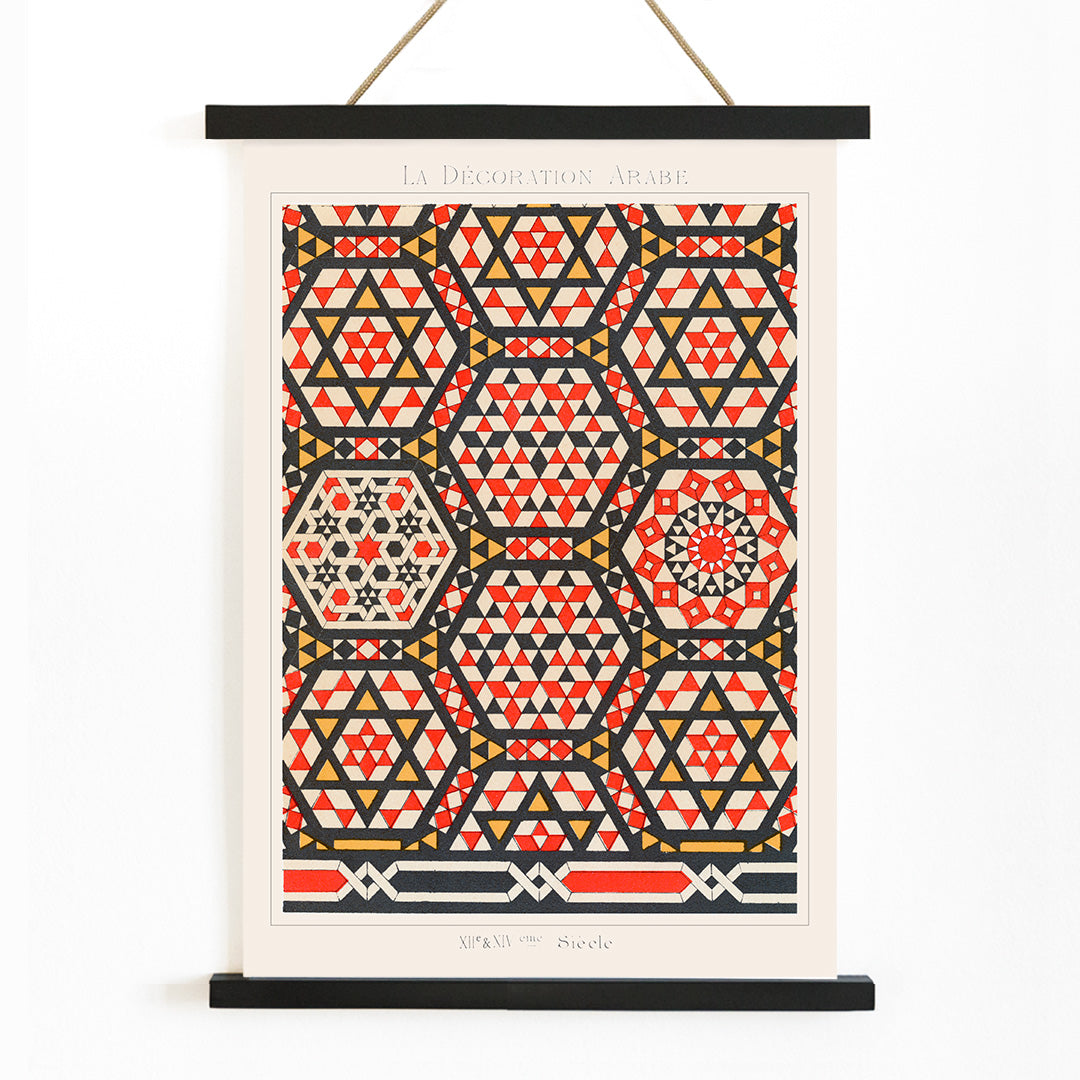
La Decoration Arabe 2 is part of a celebrated series of pattern plates produced to document and disseminate the sophisticated ornamentation found in Islamic architecture. Created during a period of heightened European fascination with global decorative arts, these plates were used as educational tools in museums, design schools, and workshops.
This particular print reflects the nineteenth-century drive to catalogue and share design knowledge internationally, offering a window into the ways motifs traveled and influenced artistic practices far beyond their origins. It stands as a testament to the enduring appeal and adaptability of geometric design.
Style & Characteristics
The artwork features a meticulously balanced geometric composition, with interlacing lines and star-shaped polygons forming a dense, harmonious tessellation. The pattern is framed by a strong border, evoking the sense of a segment taken from a grand architectural surface.
Rich reds and warm yellows contrast with pale background areas, while crisp black outlines define each element with clarity. The mood is rhythmic and orderly, making it especially appealing to admirers of oriental art and those drawn to abstract geometric prints.
In Interior Design
This geometric print serves as a striking focal point in spaces such as living rooms, entryways, or studies, where its structure can bring visual order and interest. It pairs effortlessly with minimalist or mid-century interiors that emphasize clean lines and bold forms.
To complement its palette, consider surrounding it with warm neutrals, natural woods, and black accents, or introduce textiles that echo its red and yellow hues. Displayed in a simple black or light wood frame, it offers a refined, gallery-style presentation.