


You may also like
-
Birds from the tombs of Nevoethph and Menothph Poster
Jean François Champollion · 1840 · Egyptian birds poster with stylized profiles and bold red, blue, and black details
Poster from €9 · Framed from €16
Regular price From €6,00Regular price -
Tomb of Rotei Poster
Jean François Champollion · 1840 · Archaeological vintage print showing Egyptian wrestlers with crisp hieroglyphic bands on warm paper
Poster from €9 · Framed from €16
Regular price From €6,00Regular price -
A Jungle Picnic 15 Poster
Clifford Webb · 1934 · Stylized jungle birds poster featuring elegant cranes amid lush green foliage
Poster from €9 · Framed from €16
Regular price From €6,00Regular price -
Parrots I Poster
Institut of Leipzig · 1972 · Vibrant parrot print arranged like a natural history plate with crisp scientific detail
Poster from €9 · Framed from €16
Regular price From €6,00Regular price


-

"Very nice Posters. The quality is amazing and we received it very quickly !"
-

"A shop to visit absolutely. Huge selection of posters. We spent more than an hour there !"
-

"Perfect to find gift. Price are very good. An they can frame and pack it on site"


About the Artist
Jean François Champollion was a pioneering French scholar whose decipherment of Egyptian hieroglyphs laid the foundation for modern Egyptology. His dedication to documenting ancient sites extended beyond language, as he advocated for the meticulous visual recording of tomb art to preserve knowledge before it was lost to time. The 1840s marked a period of intense archaeological exploration, with Champollion’s work inspiring both scientific inquiry and artistic appreciation of Egypt’s rich heritage.
For further exploration, discover our science inspired prints and Oriental wall art collections.
The Artwork
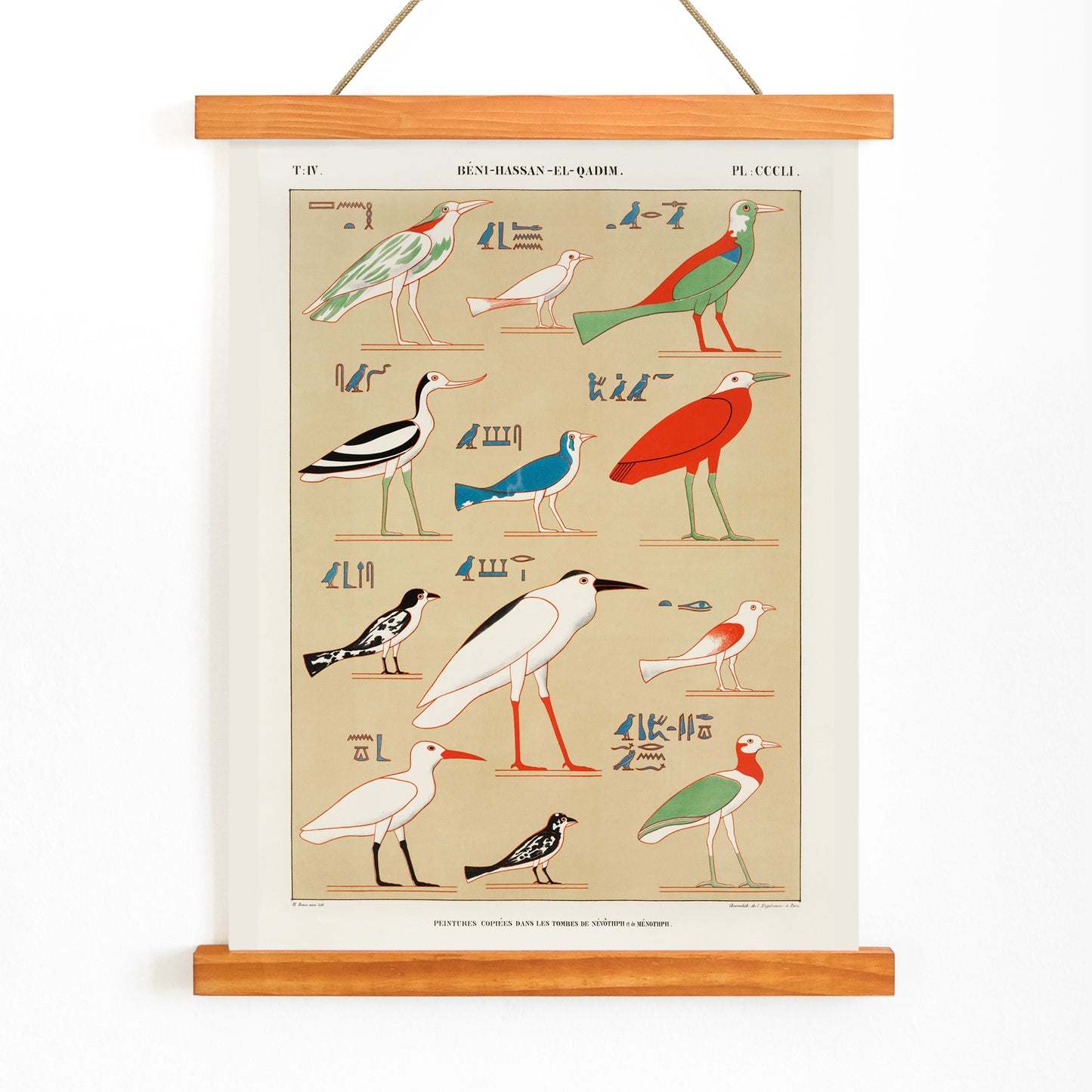
This plate was created as part of a systematic effort to record the decorative motifs found in the tombs of Nevoethph and Menothph. In nineteenth-century Egyptology, such documentation was crucial for cataloguing the visual language of ancient civilizations. Birds, frequently depicted in tomb art, symbolized the fertility of the Nile and the order of the natural world, while also serving as identifiable species within the broader symbolic context of Egyptian belief.
The print embodies the spirit of early archaeological documentation, reflecting a time when European scholars sought to understand and preserve the visual culture of pharaonic Egypt for future generations.
Style & Characteristics
The artwork is arranged as a reference plate, featuring a series of birds depicted in clear profile, each with distinctive markings and stylized forms. The use of flat, solid colors and sharp outlines recalls the aesthetic of ancient Egyptian wall paintings, emphasizing clarity and symbolic presence over naturalistic detail.
The palette consists of a warm beige background accented by red, green, blue, and white, lending the composition a harmonious and timeless quality. The overall effect is calm and methodical, evoking the measured approach of museum documentation and appealing to those drawn to classic, scholarly art prints.
In Interior Design
This Egyptian birds print brings a sense of history and quiet sophistication to studies, hallways, or living rooms. Its structured layout and elegant profiles suit minimalist, modern, and mid-century interiors, while also complementing eclectic spaces that blend travel-inspired decor with antique touches.
Pair it with sand, linen, or off-white walls, and echo its blue or green accents with ceramics or textiles. It also works beautifully within a curated display of animal themed wall art.