


You may also like
-

Sherlock Holmes Poster
Unknown artist · 1901 · Dramatic Sherlock Holmes poster featuring pipe and deerstalker in stark black, white, orange
Poster from €9 · Framed from €16
-

Das kleine Witzblatt Poster
Julius Klinger · 1901 · Advertising poster as a bold vintage print in black and orange
Poster from €9 · Framed from €16
-

Shaw or Irony Poster
Egon Schiele · 1910 · Expressive lecture poster with angular figure, black linework, and warm orange accents
Poster from €9 · Framed from €16
-

The Man of Letters Poster
Moriz Jung · 1911 · Witty Viennese café poster featuring a solitary reader in bold flat colors
Poster from €9 · Framed from €16


-

"Very nice Posters. The quality is amazing and we received it very quickly !"
-

"A shop to visit absolutely. Huge selection of posters. We spent more than an hour there !"
-

"Perfect to find gift. Price are very good. An they can frame and pack it on site"


About the Artist
Seymour Chwast is a pivotal American graphic designer and illustrator, best known as a co-founder of Push Pin Studios, the influential New York collective that transformed postwar visual culture. Throughout the 1960s and 1970s, Chwast’s work introduced historical references, sharp wit, and bold typography into the language of modern poster design.
His images are celebrated for their immediate impact and conceptual depth, blending pop sensibility with intellectual humor. For more influential graphic design, discover our famous artists posters collection.
The Artwork
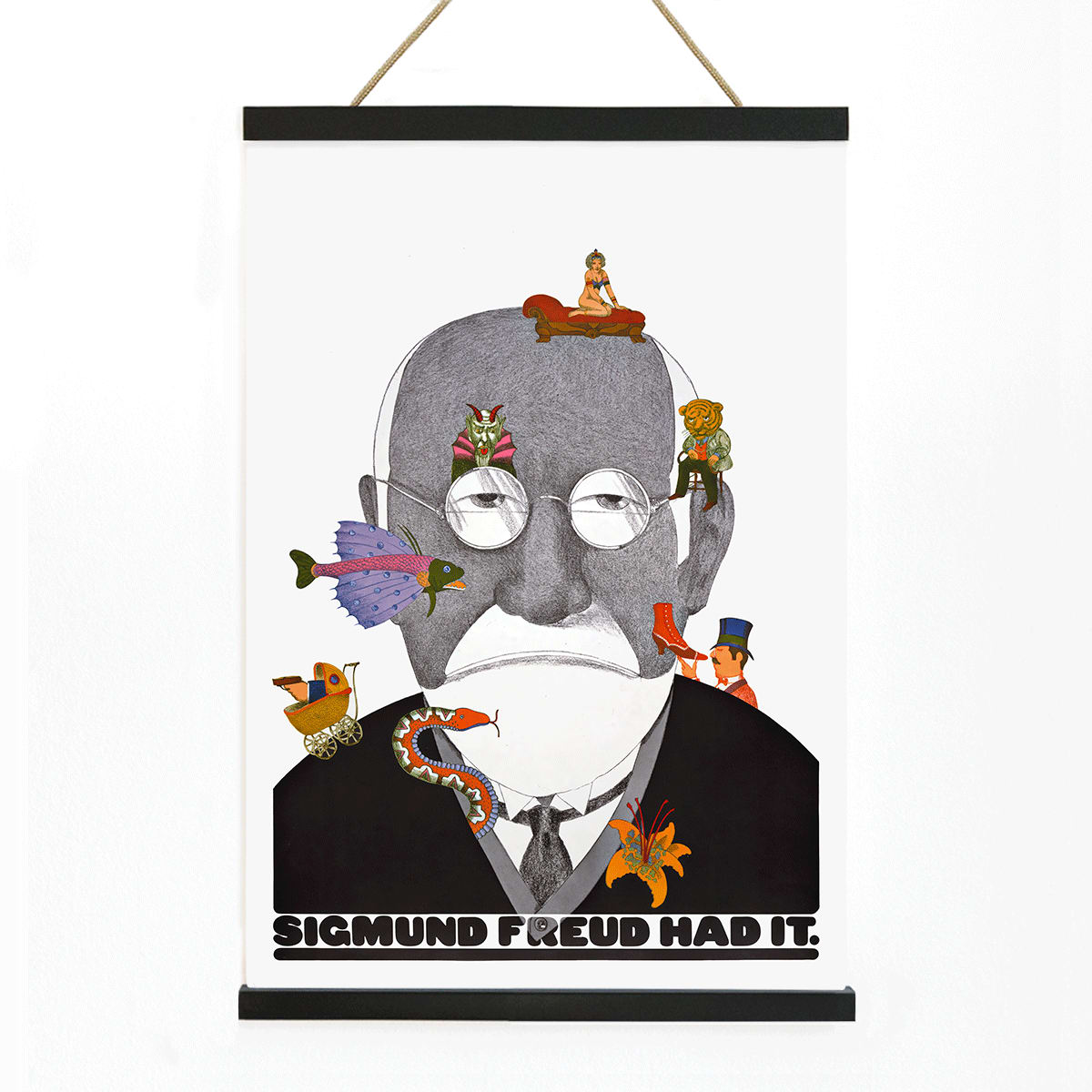
Created in 1970, this Sigmund Freud poster reflects the era’s fascination with psychology and the growing cultural presence of Freud as a symbol of introspection and modern anxieties. Rather than depicting Freud as a remote scholar, Chwast transforms him into an instantly recognizable icon, mirroring society’s engagement with therapy and self-examination during the late twentieth century.
The poster’s playful phrase and visual wit invite viewers to reflect on the nature of psychological analysis and the popularization of Freud’s ideas. This piece bridges the worlds of art history and popular culture, making it a natural fit within our science and psychology wall art selection.
Style & Characteristics
This portrait poster employs simplified forms and high-contrast design to ensure Freud’s face is immediately legible. The composition features a primarily black and white palette, with subtle grey shading and bold accents of orange and green that energize the image and introduce a surreal, playful quality.
Crisp outlines, flat shapes, and assertive typography evoke the editorial spirit of late modernist graphic design. The overall mood is witty and slightly surreal, making this artwork a striking conversation piece in any setting.
In Interior Design
This Seymour Chwast art print is well suited to studies, offices, library corners, or living rooms seeking sophisticated wall decor with character. Its bold design complements mid-century modern interiors, Bauhaus-inspired spaces, and eclectic rooms filled with books and design objects.
To echo the poster’s palette, consider a simple black frame, touches of orange in textiles, and green accents through plants or ceramics. For a cohesive gallery wall, pair it with other vertical posters in a hallway or creative studio.