


You may also like
-
Panthera Onca Poster
Charles Dessalines D'Orbigny · 1856 · Detailed jaguar print with bold rosettes and a poised, watchful profile
Poster from €9 · Framed from €16
Regular price From €6,00Regular price -
Female Lion Poster
Charles Dessalines D'Orbigny · 1849 · Tender lioness with cubs print rendered in soft brown and grey shading
Poster from €9 · Framed from €16
Regular price From €6,00Regular price -
Different types of butterfly Poster
Charles Dessalines D'Orbigny · 1849 · Detailed butterfly scientific print with vibrant yellow, white, and black wings
Poster from €9 · Framed from €16
Regular price From €6,00Regular price -
Citrus Limonium Poster
Charles Dessalines D Orbigny · 1849 · Detailed lemon botanical print with fruit, blossoms, and glossy leaves on cream
Poster from €9 · Framed from €16
Regular price From €6,00Regular price


-

"Very nice Posters. The quality is amazing and we received it very quickly !"
-

"A shop to visit absolutely. Huge selection of posters. We spent more than an hour there !"
-

"Perfect to find gift. Price are very good. An they can frame and pack it on site"


About the Artist
Charles Dessalines D Orbigny was a nineteenth-century French naturalist and illustrator whose work bridged scientific inquiry and artistic skill. At a time when illustrated encyclopedias and museum collections were expanding public understanding of the natural world, D Orbigny played a key role in making zoological knowledge accessible through detailed imagery.
His illustrations reflect the era’s dedication to scientific accuracy and educational value, making his work a touchstone for those interested in the history of natural history illustration and the evolution of science prints.
The Artwork
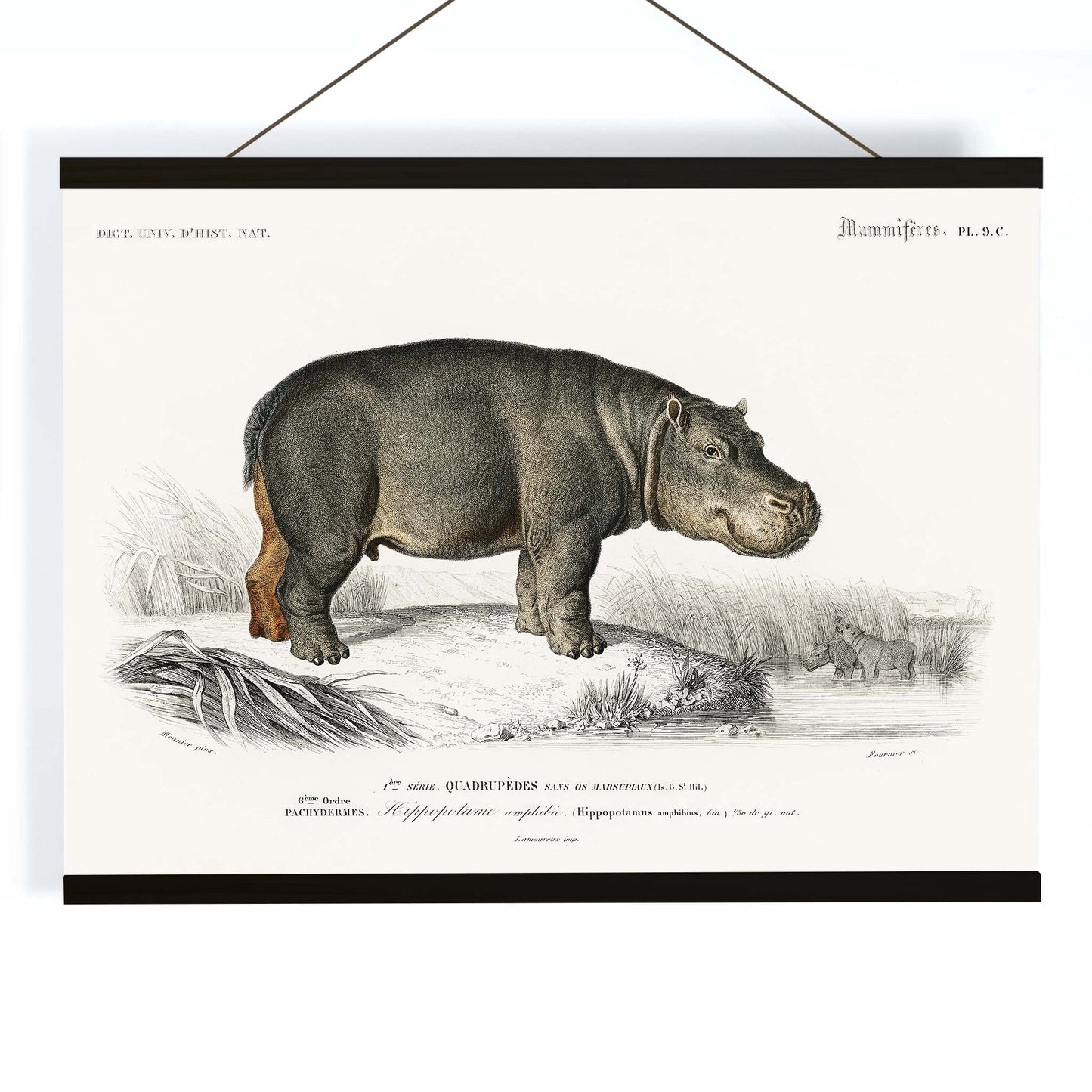
Created in 1868, Hippopotame Amphibie exemplifies the educational mission of nineteenth-century natural history plates. Produced for reference books and academic collections, this image introduced European audiences to the hippopotamus, an animal that fascinated readers through reports from explorers and naturalists.
Such works helped standardize zoological knowledge, transforming individual observations into widely recognized representations. This print stands as a testament to the period’s drive to document and share the diversity of the animal kingdom, reflecting both scientific rigor and a sense of wonder.
Style & Characteristics
The artwork features a calm, side-profile view of the hippopotamus, rendered with precise outlines and subtle tonal shading. The palette is understated, with gentle greys and warm browns set against a pale background, characteristic of classic nineteenth-century natural history prints.
The focus is on anatomical accuracy rather than dramatic setting, with careful attention to the animal’s form and texture. The overall effect is one of quiet observation, appealing to those who appreciate animal illustrations with a scholarly, museum-like quality.
In Interior Design
This hippopotamus print brings a refined, intellectual touch to offices, libraries, or study spaces, as well as children’s rooms designed for curiosity and learning. Its neutral tones complement wood, leather, and stone finishes, and it fits seamlessly into interiors with beige, taupe, or charcoal accents.
For a cohesive gallery wall, pair it with other vintage zoological works or integrate it into classic art displays for a curated, timeless look. Its subtle color scheme also suits minimalist or modern rooms that benefit from a hint of nineteenth-century scientific charm.