


You may also like
-
Don’t be a sucker Poster
Unknown artist · 1944 · Bold wartime poster featuring a fish and hook as a warning against manipulation
Poster from €9 · Framed from €16
Regular price From €6,00Regular price -
United we are strong Poster
Henry Koerner · 1943 · WWII poster featuring Allied flags rising above cannons in bold graphic style
Poster from €9 · Framed from €16
Regular price From €6,00Regular price -
Off telephone lines Poster
Unknown artist · 1964 · Bold safety poster featuring a kite tangled on telephone lines in black and white
Poster from €9 · Framed from €16
Regular price From €6,00Regular price -
Destroy this mad brute Poster
Harry Ryle Hopps · 1917 · Dramatic wartime poster featuring a helmeted gorilla advancing with club and captive
Poster from €9 · Framed from €16
Regular price From €6,00Regular price


-

"Very nice Posters. The quality is amazing and we received it very quickly !"
-

"A shop to visit absolutely. Huge selection of posters. We spent more than an hour there !"
-

"Perfect to find gift. Price are very good. An they can frame and pack it on site"


About the Artist
Stevan Dohanos was an American illustrator renowned for his ability to capture everyday life with clarity and narrative depth. Rising to prominence through his covers for The Saturday Evening Post, Dohanos also played a significant role in shaping US government visual culture during World War II. His posters, designed to communicate urgent messages to the public, reflect a balance of realism and graphic impact that defined American wartime illustration.
Collectors of midcentury graphics and documentary imagery appreciate Dohanos's work for its historical resonance and its place within the tradition of vintage advertising posters and classic American illustration.
The Artwork
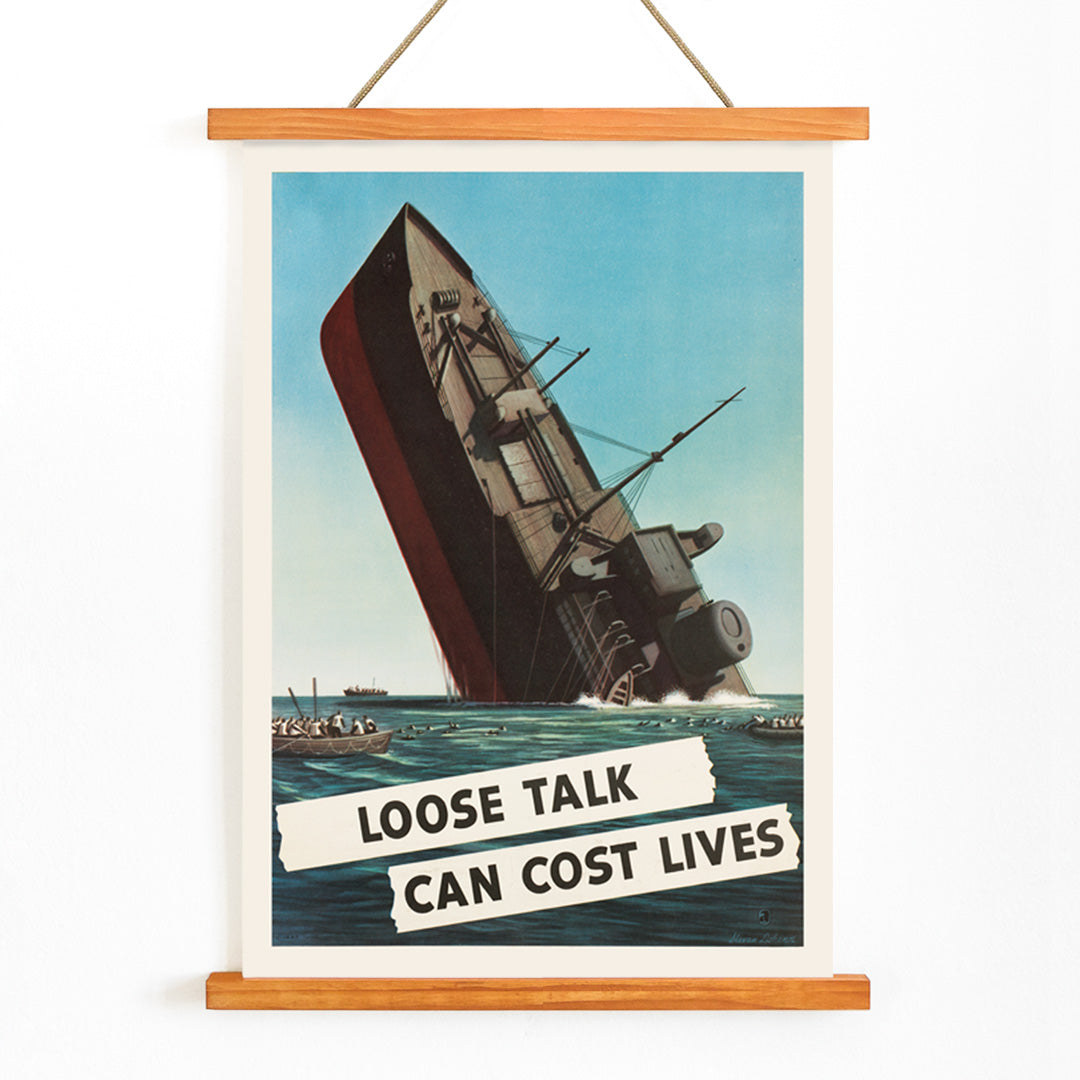
Loose talk can cost lives was created in 1942 as part of the US government's campaign to promote operational security during World War II. At a time when the threat of espionage and information leaks was a national concern, posters like this urged civilians to guard their conversations to protect military operations and lives. The artwork embodies the era's heightened sense of vigilance, serving as a visual reminder of the collective responsibility required on the home front.
This piece stands as a testament to how design and public messaging were harnessed to foster unity and caution during a pivotal moment in history.
Style & Characteristics
The poster features a dramatic scene of a ship sinking in a turbulent, dark blue sea, immediately drawing the viewer's attention. Above, bold white and red typography delivers the urgent warning, dominating the upper portion of the composition. The contrast between the deep ocean hues and the stark lettering creates a sense of alarm and immediacy, while the simplified forms ensure the message is clear even from a distance.
The overall effect is one of tension and clarity, characteristic of effective wartime graphic design. This visual language aligns well with other sea and ocean wall art and midcentury posters.
In Interior Design
This vintage poster makes a striking statement in offices, libraries, or hallways, where its historical message and bold design invite reflection. Its vertical format is ideal for narrow spaces or as a focal point within a gallery wall arrangement.
Pair it with interiors featuring navy, charcoal, and crisp white tones, and echo the red accents in accessories or framing. For a cohesive look, consider combining it with other blue toned prints and nautical or industrial decor elements for a space that feels both modern and historically grounded.