


You may also like
-
Seated nude with crossed legs I Poster
Henri Matisse · 1941 · Minimalist art print of a seated nude with crossed legs
Poster from €9 · Framed from €16
Regular price From €6,00Regular price -
Nu Bleu III Poster
Henri Matisse · 1952 · Iconic blue nude art print with flowing cut-out silhouette on warm beige
Poster from €9 · Framed from €16
Regular price From €6,00Regular price -
Vierge et enfant Poster
Henri Matisse · 1950 · Minimalist art print of a mother and child in spare black line
Poster from €9 · Framed from €16
Regular price From €6,00Regular price -
Veiled head Poster
Henri Matisse · 1950 · Veiled head becomes a refined art print with graceful black linework
Poster from €9 · Framed from €16
Regular price From €6,00Regular price


-

"Very nice Posters. The quality is amazing and we received it very quickly !"
-

"A shop to visit absolutely. Huge selection of posters. We spent more than an hour there !"
-

"Perfect to find gift. Price are very good. An they can frame and pack it on site"


About the Artist
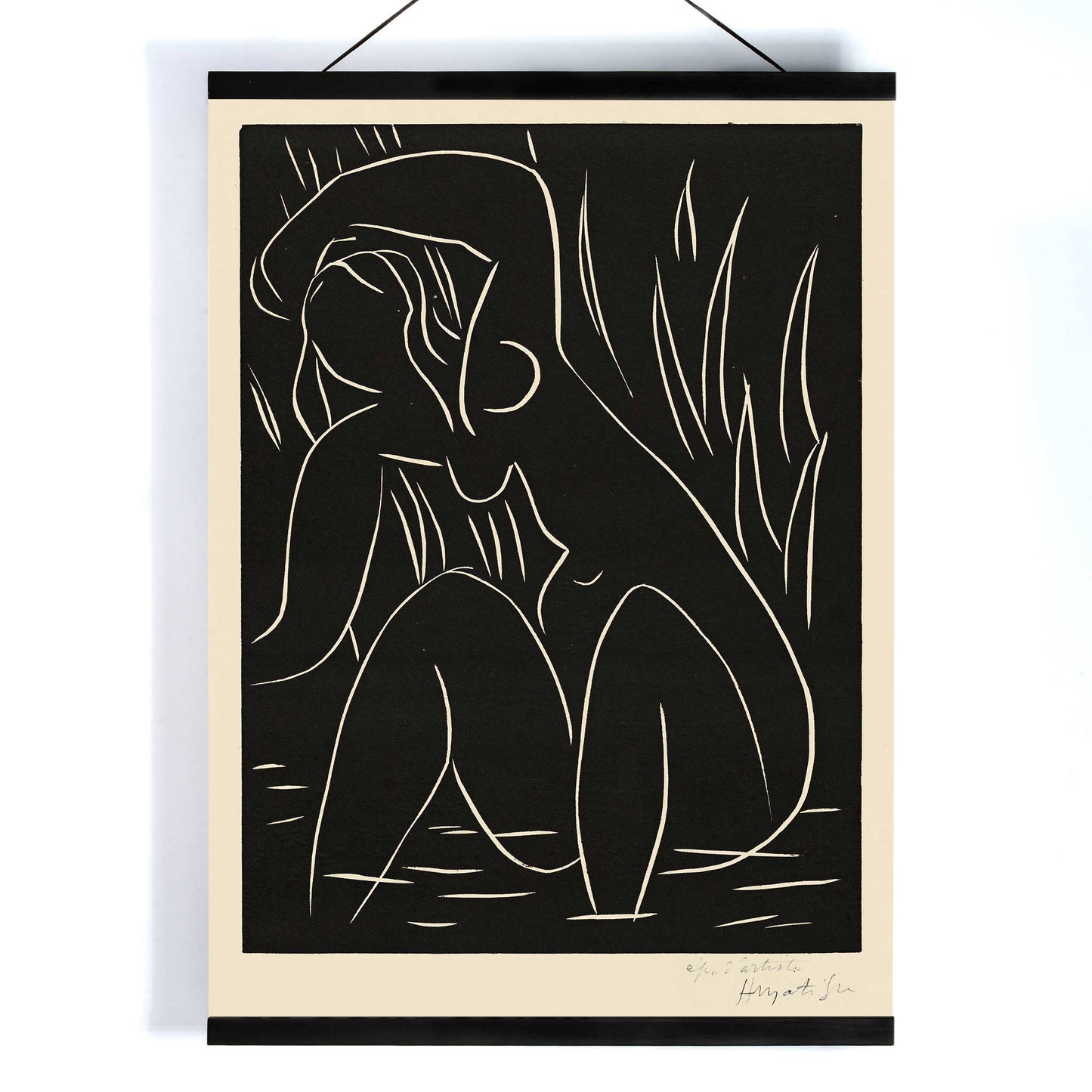
Henri Matisse uses The Afternoon to show how far a single line can go in a vertical poster. In 1941, after illness narrowed his working routine, he leaned into clarity and left behind the crowded surfaces of his earlier years. That shift gives this art print its authority: the artist does not narrate a scene so much as distill one. For collectors of Matisse wall art, the work offers a late glimpse of his search for economy, turning a simple figure into a poised piece of home decor and fine art print history.
The Artwork
The image was made in wartime France, when the studio could feel like a private refuge from interruption. The reclining figure suggests an hour of rest, but the title keeps the moment open, as if the scene might expand into memory or pause again at any time. Matisse revisits a favorite subject here, not to repeat it, but to reduce it to essentials. As a vintage poster and vintage print, it carries the sense of an artist refining a familiar motif until only the most necessary gesture remains, which is why the image still reads as intimate modern home decor.
Style & Characteristics
Against a deep black ground, pale contour lines trace the body with a restrained, handwritten confidence. Tall leaflike strokes climb behind the figure, while the bent knees and tucked head create a compact silhouette that feels almost carved out of darkness. The cream border softens the contrast and gives the black and white composition a paper-and-ink presence. This minimalist art print depends on the rhythm of repeated curves, the long sweep of the back, and the small arcs at the base that hint at a floor or water without fully naming either.
In Interior Design
Placed in a reading nook, this vertical poster brings a calm, modern edge to a room with warm wood and linen textures. The dark field gives a dining corner or hallway wall a steady focal point, while the pale border keeps the image from feeling heavy. Framed simply, it works as wall art that adds structure without noise, especially where interior decoration benefits from one strong black and white note. Its quiet figure draws the eye upward and settles the surrounding space into a more measured rhythm.