


You may also like
-

Transparent Solar System Poster
James Reynolds · 1851 · Detailed solar system scientific print with labeled orbits and hand-tinted planetary accents
Poster from €9 · Framed from €16
-

Diagram of Meteorology Poster
James Reynolds · 1846 · Detailed meteorology poster mapping winds and cloud forms in hand-colored diagrams
Poster from €9 · Framed from €16
-

Transparent Chart of the Heavens Poster
James Reynolds · 1850 · Ingenious celestial map poster featuring a rotating sky chart with labeled constellations
Poster from €9 · Framed from €16
-

View of lenses Poster
James Reynolds · 1850 · Educational optics print displaying precise lens diagrams in crisp black ink on beige
Poster from €9 · Framed from €16


-

"Very nice Posters. The quality is amazing and we received it very quickly !"
-

"A shop to visit absolutely. Huge selection of posters. We spent more than an hour there !"
-

"Perfect to find gift. Price are very good. An they can frame and pack it on site"


About the Artist
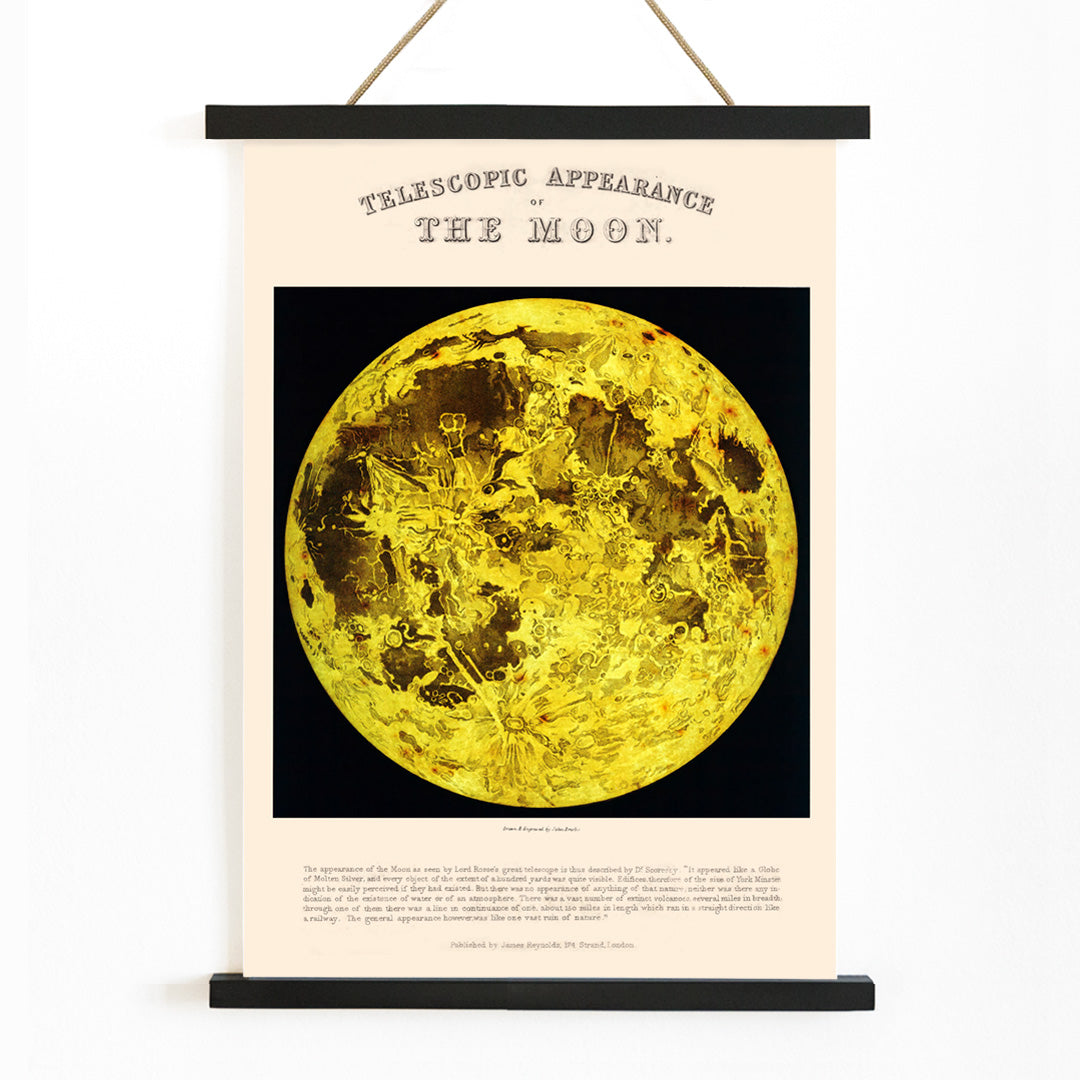
James Reynolds is credited with this 1850 lunar study, created during a period when scientific illustration played a vital role in making astronomical discoveries accessible to the public. Although little is known about Reynolds' personal history, his work reflects the close collaboration between astronomers, publishers, and artists in the nineteenth century.
The presence of Reynolds' name on the print marks an era when skilled draughtsmanship and printmaking were indispensable to scientific exploration. For those interested in vintage moon imagery, this piece fits seamlessly within our space wall art collection.
The Artwork
Appearance of the Moon emerged amid the mid-nineteenth century fascination with telescopic observation and the mapping of celestial bodies. As advances in technology brought the Moon into sharper focus, it became a symbol of scientific progress and human curiosity.
This print was intended to document and communicate the lunar surface as seen through powerful telescopes, transforming fleeting observations into enduring references. It embodies the spirit of popular science publishing, bridging the gap between academic circles and the broader public, and reflecting the excitement surrounding landmark instruments like Lord Rosse's telescope.
Style & Characteristics
The artwork features a single, detailed circular depiction of the Moon, reminiscent of a scientific atlas plate. Fine shading and tonal gradations suggest the craters and ridges, offering a tactile sense of the lunar landscape without painterly embellishment.
Rendered in dark ink on warm-toned paper, the palette consists of black and beige, with subtle aged highlights that evoke an archival atmosphere. The overall effect is precise and contemplative, characteristic of classic scientific prints. For those drawn to monochrome clarity, explore our black and white posters for similarly focused works.
In Interior Design
This lunar illustration serves as thoughtful wall decor in studies, home offices, hallways, or reading corners, sparking conversation about exploration and history. It complements modern, industrial, minimalist, and classic interiors, bringing a scholarly vintage presence to any space.
Pair it with beige walls, black frames, brass accents, or muted ochres to echo the tones of aged paper. It also integrates beautifully into a gallery wall with maps and instruments, or alongside other science art prints for a cohesive cabinet of curiosities aesthetic.