


You may also like
-
Bijutsukai Pl.218 Poster
Korin Furuya · 1901 · Stylized chrysanthemum poster balanced by soft geometric blocks and airy negative space
Poster from €9 · Framed from €16
Regular price From €6,00Regular price -
Bijutsukai Pl.169 Poster
Korin Furuya · 1901 · Delicate butterflies drift above white hydrangeas in a serene Japanese floral poster
Poster from €9 · Framed from €16
Regular price From €6,00Regular price -
Kanagawa Great Wave Poster
Katsushika Hokusai · 1830 · Iconic ukiyo-e poster of a towering wave curling over boats beneath Mount Fuji
Poster from €9 · Framed from €16
Regular price From €6,00Regular price -
The Great Wave Poster
Katsushika Hokusai · 1831 · Iconic Japanese wave poster with Mount Fuji and boats under towering surf
Poster from €9 · Framed from €16
Regular price From €6,00Regular price


-

"Very nice Posters. The quality is amazing and we received it very quickly !"
-

"A shop to visit absolutely. Huge selection of posters. We spent more than an hour there !"
-

"Perfect to find gift. Price are very good. An they can frame and pack it on site"


About the Artist
Korin Furuya was a Japanese designer and illustrator active during the Meiji era, a period marked by the modernization of art education and a renewed appreciation for traditional decorative arts. His work is closely associated with the Rimpa school’s influence, where stylized nature motifs and rhythmic patterns played a central role in visual culture. Furuya contributed to the evolution of Japanese design by creating pattern books that inspired artisans across various crafts.
His legacy endures through these design albums, which continue to attract collectors interested in the intersection of Japanese tradition and early modern aesthetics.
The Artwork
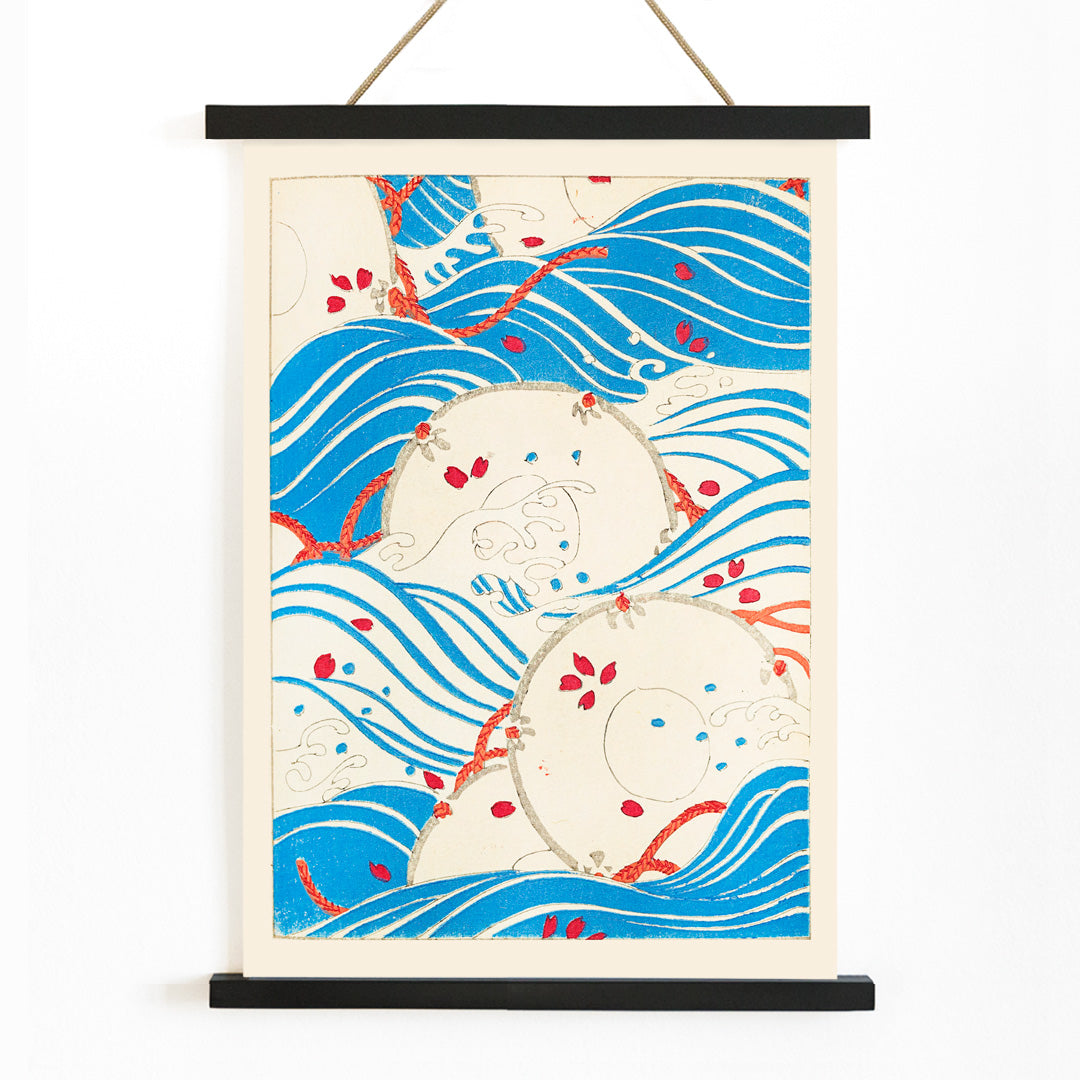
This plate, Bijutsukai 175, was published in 1901 as part of a Japanese art periodical that served as a sourcebook for artists, craftsmen, and students. Such publications offered a wealth of ornamental models, encouraging the adaptation of motifs across textiles, ceramics, lacquerware, and interiors. The wave motif featured here reflects a deep cultural reverence for nature’s rhythms, embodying both energy and tranquility. These design plates were instrumental in shaping the visual language of the time, bridging classical inspiration with emerging modern sensibilities. For more examples of Japanese decorative art, explore our Japanese and Asian-inspired wall decor and blue tone art prints collections.
Style & Characteristics
The composition presents a decorative field of stylized, sweeping wave forms rendered in bold blue against a pale background. Delicate red accents punctuate the design, while subtle gray linework adds definition and movement. The use of crisp outlines and flat color areas creates a clean, graphic effect that feels both rooted in tradition and strikingly modern. The overall mood is serene and balanced, with the rhythmic repetition of curves evoking a sense of calm energy. This artwork pairs well with other sea and ocean wall art and minimalist interiors.
In Interior Design
This vintage Japanese poster is well-suited for spaces where you wish to introduce a sense of movement without overwhelming the room. Its cool palette and flowing lines complement light-filled living rooms, tranquil bedrooms, or serene workspaces. Framing it with pale wood, matte black, or simple white mats enhances its refined presence. The design harmonizes beautifully with Japandi, minimalist, and contemporary coastal styles, and serves as a subtle anchor on a gallery wall alongside ceramics or other patterned prints.